Advanced Maze Rescue Robot
Advanced Maze-Solving Rescue Robot Design & Development Course
Enter the World of Algorithms, Intelligent Engineering, and Complex Pathfinding!
Imagine a robot entering an unknown and complex maze, detecting walls and possible paths, making intelligent decisions, and independently finding its way through a challenging environment!
This is exactly the challenge students experience in our Advanced Maze-Solving Rescue Robot Course.
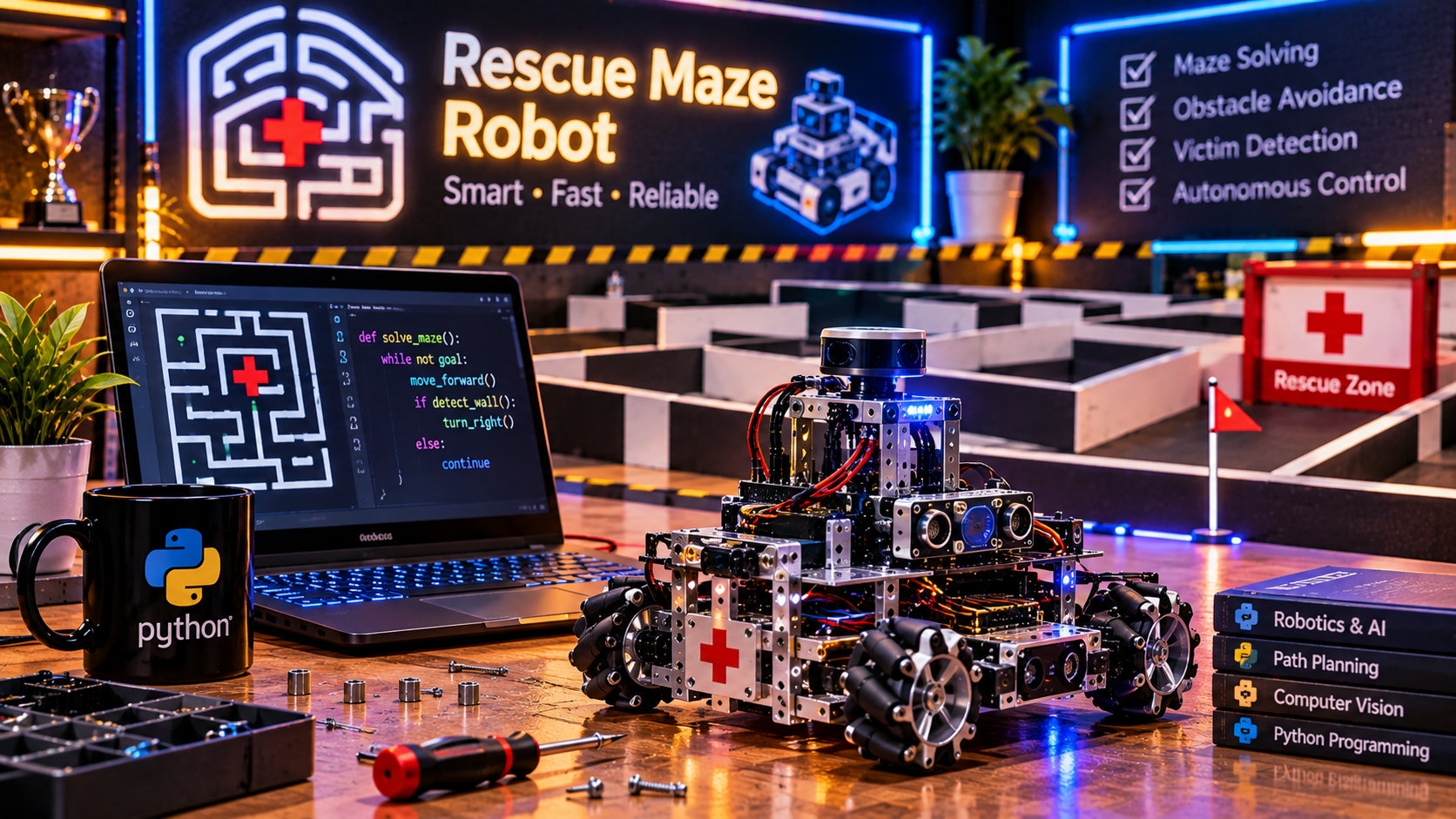
In this course, students explore advanced robotics by combining mechanical engineering, electronics, and programming to design and develop an intelligent maze-solving robot.
In the mechanical engineering section, students learn the fundamentals of robot structure, chassis design, movement systems, and component placement. They design and develop the mechanical system required for their own robot.
In the electronics section, students identify the necessary components and sensors, design the robot's electronic system, and learn how to integrate sensors, motors, and control circuits into a coordinated hardware platform.
The most challenging part of the course is specialized programming and maze-solving algorithm development. Students learn how to collect and analyze environmental data through sensors, identify different paths, make decisions, and use search and pathfinding algorithms to navigate complex mazes.
Course Topics & Specialized Skills
1. Mechanical Engineering & Robot Design
Understanding the mechanical structure of maze-solving robots
Designing the robot chassis and body according to maze dimensions
Selecting and evaluating motors and movement systems
Designing suitable mounting positions for sensors and electronic components
Evaluating mechanical stability, dimensions, and performance
Assembling and optimizing the mechanical structure
2. Electronics Design & Development
Understanding the electronic components of maze-solving robots
Exploring different wall and path detection sensors
Designing the robot's motor control system
Learning about motor drivers and control circuits
Integrating sensors, processors, and movement systems
Developing and implementing the robot's electronic architecture
3. Advanced Programming & Maze-Solving Algorithms
Understanding the operating principles of maze-solving robots
Developing specialized robot movement and control programs
Collecting and processing sensor data
Detecting walls, open paths, and dead ends
Learning maze exploration and navigation algorithms
Implementing pathfinding and search algorithms
Developing decision-making logic for intersections and complex routes
Optimizing navigation paths and reducing completion time
Testing, debugging, and improving robot algorithms
What Makes This Course Different?
Solving a maze is about much more than simply moving through a path. A robot must understand its surroundings, analyze the information it receives, and make decisions based on its observations.
In this course, students face real engineering challenges and learn how to design and develop a complete robotic system from the ground up.
Instead of relying on a ready-made robot, they take part in mechanical design, electronic system development, and specialized algorithm programming. They then test the results of their work using a real maze environment.
Beyond Building a Robot: The Art of Problem-Solving!
Maze-solving robots represent one of the most exciting areas of robotics education because they combine multiple engineering disciplines with algorithmic thinking and intelligent decision-making.
Throughout this course, students learn how to transform an initial idea into an autonomous robotic system capable of analyzing its environment, finding its own path, and overcoming complex challenges.
Every dead end is a challenge, and every path is an opportunity to make an intelligent decision!
What you will achieve
Design and implement their own maze robot's mechanical structure.
Develop the electronic system and required sensors.
Write movement and control programs.
Implement specialized maze exploration and pathfinding algorithms.
Test and optimize robot performance in complex environments.
Improve their analytical thinking and algorithmic problem-solving skills.
Prepare for advanced robotics projects and technical competitions.