Electronics
Electronics Training Course for Kids
Discover the Amazing World of Electronics: From Understanding Components to Building Real Circuits!
Have you ever wondered how lights turn on, how electronic circuits work, or how different devices communicate with one another?
In our Electronics Course for Kids, students explore the fascinating world of electronics through simple explanations and practical, hands-on activities. They learn the fundamental principles behind electronic components and circuits.
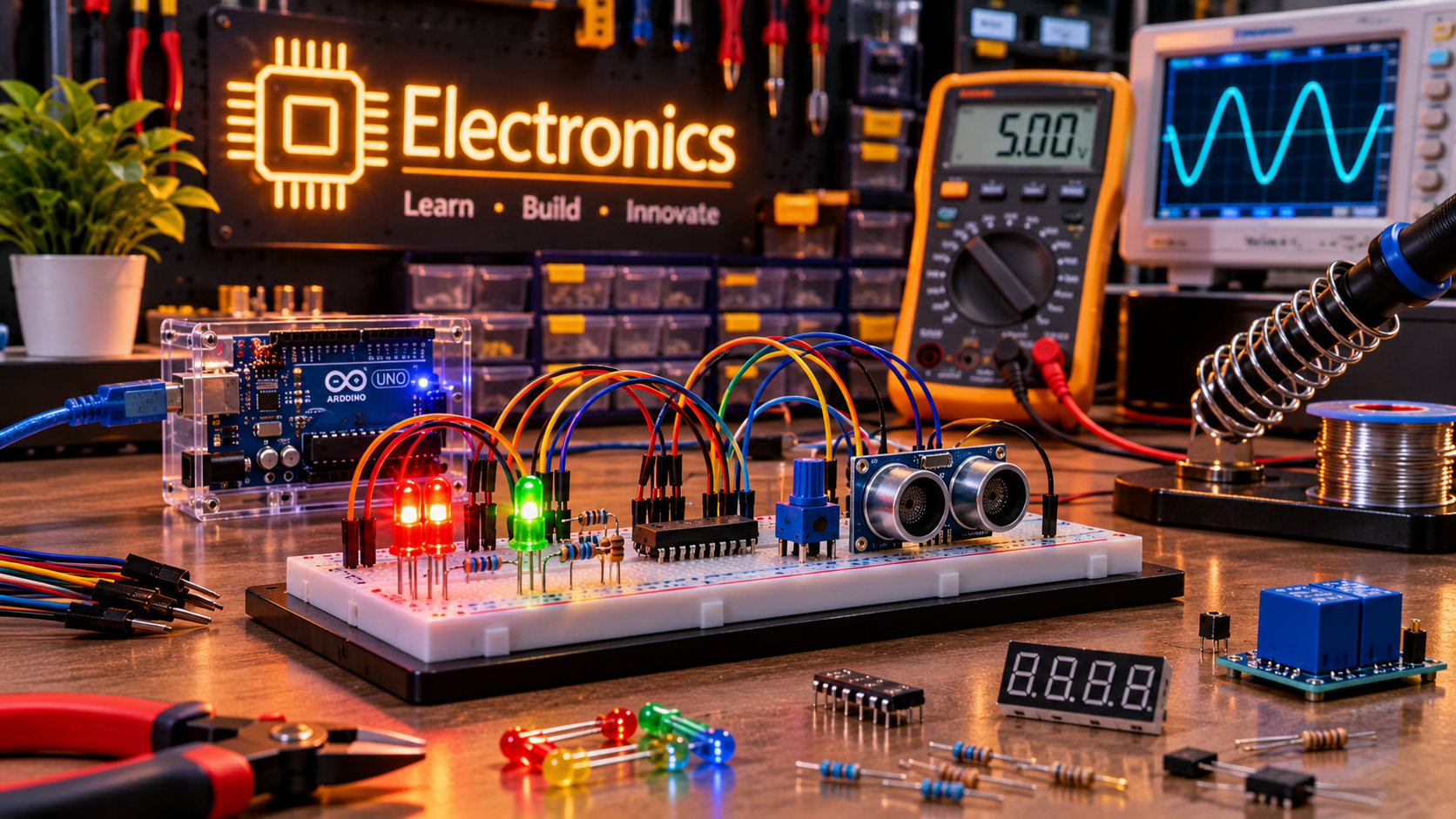
Students begin by identifying common electronic components such as resistors, capacitors, LEDs, diodes, switches, transistors, and other basic elements. They learn how these components work and understand their applications in electronic circuits.
Using breadboards, students then build and test different electronic circuits without the need for soldering. Through practical experiments, they observe how circuits operate and gain a clear understanding of basic electronic concepts.
As they progress, students are introduced to soldering techniques and learn how to mount electronic components onto printed circuit boards (PCBs). Under instructor supervision, they practice soldering and assembling electronic circuits while becoming familiar with the process of turning a simple circuit design into a real electronic board.
Why Is Electronics Beneficial for Children?
Electronics is much more than learning about a few components and connecting wires. It is an opportunity to develop logical thinking, understand cause and effect, and explore the technology that surrounds us every day.
Instead of focusing only on theory, students actively participate in building circuits, experimenting with components, soldering connections, and testing their designs.
All practical activities are adapted to the students' age and are performed under instructor supervision, with particular attention to safe working practices when using electronic tools.
What Will Students Gain?
By the end of this course, students will understand the basic electronic components and their applications. They will be able to build simple circuits using breadboards, apply basic soldering techniques, and assemble electronic components onto printed circuit boards.
This course provides an excellent starting point for exploring robotics, hardware programming, electronic projects, and engineering.
Every circuit is a new discovery. Here, children learn to build the world of technology with their own hands!
What you will achieve
Introduction to the world of electronics and the basic concepts of electrical circuits
Understanding electronic components and their respective applications
Familiarity with resistors, capacitors, LEDs, diodes, transistors, and switches
Learning the concepts of voltage and currentAnd how electric current flows
Understanding how to connect components and read simple circuit diagrams
Learning to work with breadboards and build circuits without soldering
Familiarity with soldering tools and observing safety precautionsSafety
Learning the basics of soldering electronic components
Assembling components on printed circuit boards (PCBs)
Building and testing practical electronic circuits